AI-driven product placement pipeline
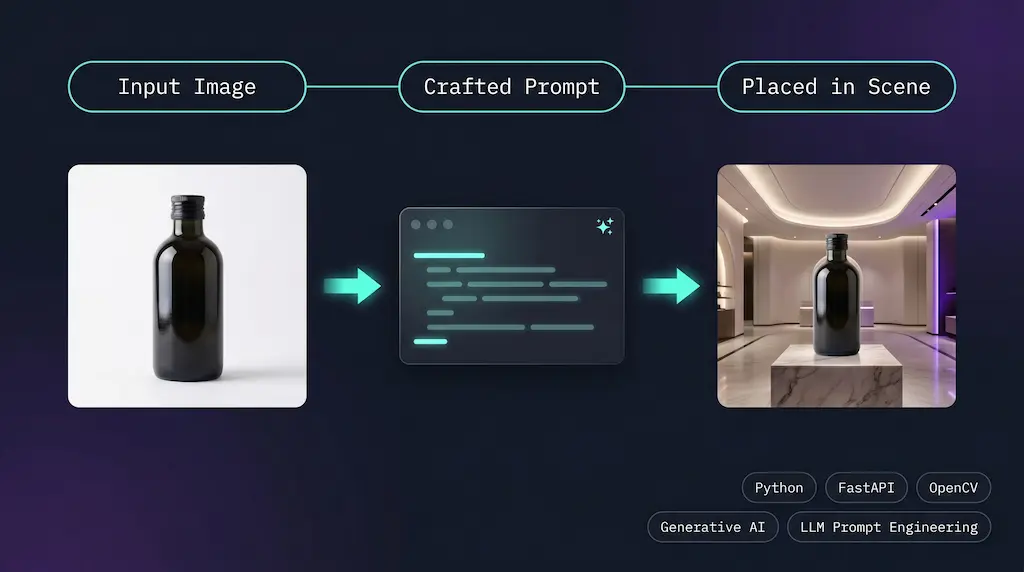
A deterministic AI pipeline that places products into 4K virtual retail environments for Emperia, replacing a 48-hour manual 3D workflow with near-instant generation.
The problem
Emperia builds high-fidelity virtual storefronts for luxury retail brands, and every product update ran through a manual 3D modelling workflow. Updating a single environment meant routing through artist availability for the Figma-to-3D translation, with even minor inventory changes consuming up to 48 hours and a one-week minimum turnaround. Production capacity was tied to artist headcount rather than client demand, and the team had no way to keep pace with rapidly changing retail catalogues.
Our approach
The hard part wasn't generation, it was preserving 4K fidelity through a pipeline that doesn't natively support it. Multimodal vision models like Gemini Pro downscale high-resolution images on input, so feeding a 4K panorama straight into the model destroyed the pixel density a luxury brand depends on. We moved away from pure generation toward a deterministic, coordinate-based pipeline, letting the model reason about placement within tightly controlled segments rather than guessing at an entire scene.
What we built
A "Crop-Process-Stitch" pipeline served through a stateless FastAPI orchestration layer. Pre-defined placement slots are identified by coordinate logic rather than visual inference, the 4K panorama is programmatically segmented into high-resolution crops, and GPT-4o and Gemini Pro reason about product orientation and scale within each segment. OpenCV and PIL re-stitch the processed segments back into the original 4K background, so the output stays a seamless, full-resolution panorama. Python's asyncio handles segment processing in parallel, so a 13-product environment completes in roughly the same time as a single-product one.
The outcome
The 48-hour manual workflow became near-instant, and product update turnaround dropped from a week to a day. The pipeline has been stress-tested at 13+ product placements in a single pass, with scalability now a function of API capacity rather than artist headcount. The production team spends its time on environment design and brand strategy, while the pipeline absorbs the repetitive placement work.