Emperia UGC CMS Infrastructure
An internal operations CMS for Emperia: automates product ingestion, replaces manual 3D approval threads, and unifies assets into one searchable repository.
The problem
Emperia builds high-fidelity interactive 3D virtual environments for global luxury brands and enterprise retailers. Because every environment mirrors a real-world product line, managing content manually introduced immense friction at scale. Backend teams were hand-mapping product data across siloed brand systems, ranging from REST APIs to CSV files, while 3D assets, background soundtracks, and custom web themes were scattered across separate folders and storage drives. The result was lost records, duplicate labor, missed brand assets, and no visibility for external brand stakeholders into the design lifecycle.
The operational & technical challenges
Onboarding multiple external retailers meant mapping an inconsistent array of data formats, from strict REST APIs and JSON endpoints to manual CSV files and XML nodes, with no unified layer to normalize them. Unstructured asset management across teams led to lost records and duplicate effort. External brand clients had no visibility into model revisions or product sign-offs, forcing slow, manual email threads. On the technical side, tracking 3D model pipelines through stakeholder reviews caused severe launch delays, while multi-tenant requirements demanded ironclad RBAC to keep corporate data isolated. The platform also had to handle thousands of active 3D geometries and large concurrent batch uploads without processing lag or downtime.
Our solution
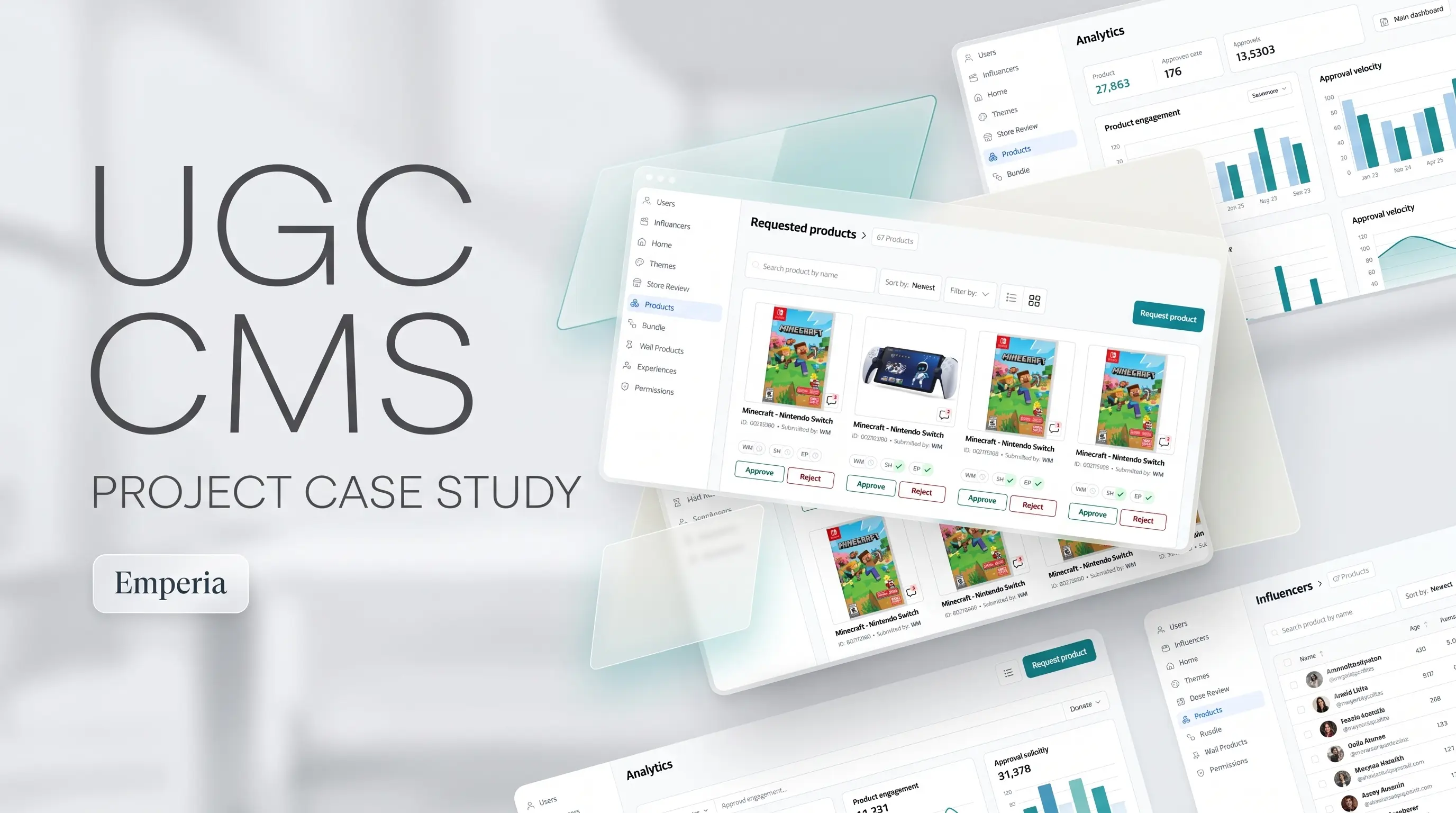
We engineered and deployed the UGC CMS, a secure, highly resilient internal operations control engine. A universal middleware layer abstracts any external retailer data source (REST, JSON, CSV, XML), normalizing varying metadata models into a single uniform product structure cached in the production database. We replaced manual approval email threads with an automated 3-step verification pipeline: 3D artists upload completed low-poly models directly into the interface; catalog teams enrich records with pricing, copy, and tags; then internal leads and external client contacts preview, approve, or reject submissions, with rejections automatically routing revision notes back to the relevant team. Centralized CRUD repositories with fast search and filtering unified virtual templates, environmental designs, and background music tracks. An enterprise-grade RBAC layer enforces strict data isolation between internal developers, catalog managers, and external brand clients.
Phased delivery
The platform was built over eight months through five continuous-delivery Agile phases backed by automated CI/CD pipelines. Phase 1 formulated the unified multi-tenant database schema and integrated the multi-format translation middleware. Phase 2 built the 3-step approval state machine with interactive model viewers and automated feedback loops. Phase 3 rolled out database tables and fast search indexing for global storefront design assets, styles, and background tracks. Phase 4 activated fine-grained RBAC to securely isolate client workspaces from internal backend systems. Phase 5 configured automated CI/CD pipelines, ran extensive security audits, and optimized availability for smooth enterprise operations.
Key lessons
Completely separating external data formats from core database schemas via a translation middleware saves hundreds of integration hours when onboarding new enterprise clients. Standardization is what unlocks real scale. Including external retail partners directly within internal review cycles through secure, isolated dashboards builds operational trust and significantly accelerates design sign-offs. And unifying scattered assets into a centralized, searchable repository cuts repetitive development effort, enabling teams to launch new brand campaigns twice as fast.